Jeremy Stolow
On 28 October, I was fortunate to be able to give a talk to CAS-E about my recently published book, Picturing Aura: A Visual Biography (MIT Press, 2025): a historical, anthropological, and philosophical study of modern efforts to visualize that hidden radiant force encompassing the living body known as ‘the aura’. My book chronicles the rise and global spread of modern instruments and techniques of picturing aura, from the late nineteenth century to the present day, exploring how its images are put to work in the diverse realms of psychical research, esotericism, art photography, popular culture, and the New Age alternative medical and spiritual marketplace. Given its empirical focus, its methodology, and its theoretical ambitions, I saw many productive points of overlap with CAS-E’s overall mission to examine “alternative rationalities and esoteric practices from a global perspective,” and I greatly profited from the discussion that followed my presentation.
As I emphasized in my talk, and as I address at much greater length in the book itself, the object of study for this research is extremely slippery and requires extensive definition and critical reflection. The aura is indeed a remarkably ambiguous phenomenon: something whose existence may or may not be subject to the known laws of naturalist explanation; something that is neither clearly physical nor metaphysical, and yet somehow is able to take visual form. Indeed, although few of us have ever seen an aura with our own eyes, we all seem to know more or less what it is supposed to look like: a faintly luminescent cloud, a warmly colored haze, a ring of flames, a solar disk, a crown of lightning. These are some of the many ways artists, healers, clairvoyants, and occult seers at different times and places have visualized auras, marking an individual presence that clings to but also radiates beyond what we normally think of as the body’s outer limit, the surface of its skin (Fig 1). A compelling esoteric vision for some, a clear instance of pseudoscientific nonsense for others, pictures of aura occupy a boundary space where diverse world-making orientations collide with one another, as these images take on lives as objects of scientific scrutiny, sources religious and esoteric insight, expressions of artistic vision, or displays of popular wonder.
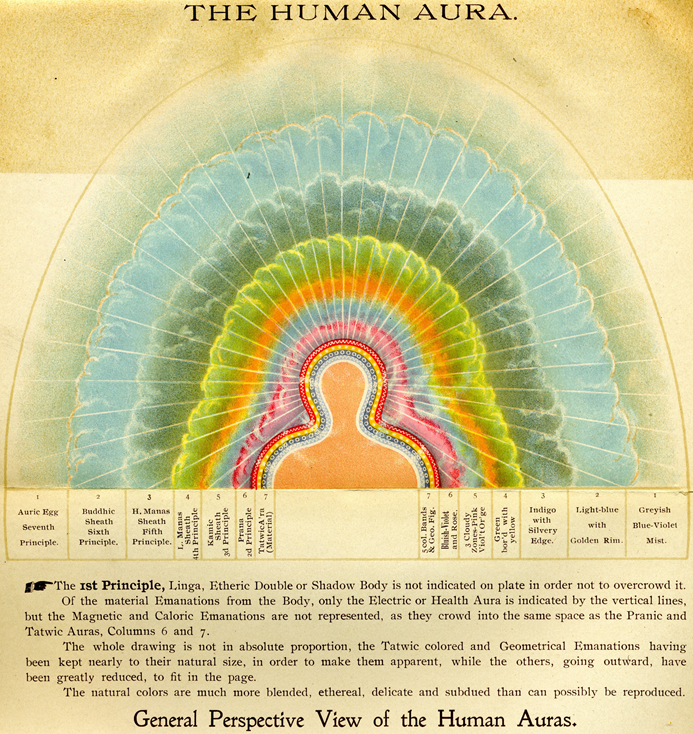
Let me be clear: this is not a book about auras per se – a topic that has been examined in a vast body of Theosophical, occultist, and New Age literatures spanning more than a century in multiple languages. It was not the main goal of this study to add to existing scholarly discussion about the history of the concept of the aura alongside related notions of subtle embodiment long thematized in diverse Western and Asian religious traditions. Nor does the book aim to provide a phenomenological account of the experience of perceiving auras, such as reported by clairvoyants, healers, and other gifted individuals who claim such abilities, and even less does this book seek to evaluate the sociological or psychological motivations of those who believe in the existence of auras. Instead, my mandate was much narrower: to reconstruct a roughly 150-year history of attempts to produce pictures of aura with the help of modern visual instruments and techniques. Put otherwise, this book recounts the history of a practice: a story about an enterprise dedicated to the visualization of something hidden, whose very hiddenness generates heated controversy, while, at the same time, has proven to be remarkably generative for so many actors in different fields of activity. Loosely inspired by the radical empiricist philosophy of William James, and taking advantage of a range of methodological tools derived from media archaeology, science and technology studies, and visual culture studies, my book brackets the question of whether auras are ‘really real’, at least according to the reigning consensus of mainstream science, in order to focus instead on the evolution of different techniques of seeing and sources of know-how that have brought auras into being as pictures. By tracing the patterns of movement of pictures and picturing instruments along their multiple routes of transmission, Picturing Aura offers the reader a set of stories about the history of formation and ongoing reproduction of this hazy borderland between religion, science, art, medicine, and popular culture, exploring the ways the techniques, apparatus, and discursive frameworks of aura visualization have migrated from one set of users to the next (Fig 2).
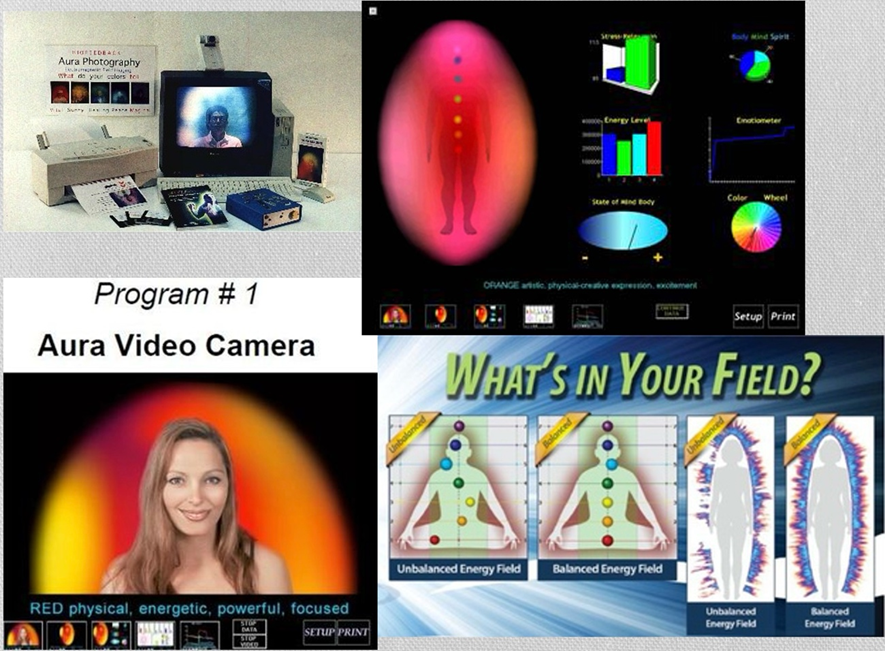
Operating at different scales of analysis – from the micro-level of individual inventors, instrument designers, parapsychologists, artists, and other agents to consideration of much more socially diffuse terrains comprising amateur hobbyists, small scale retail operators, and consumers of pictures of aura as objects of medical knowledge or personal memorabilia and ‘infotainment’ – I offer a provisional map of a vast world of activity that has largely escaped scholarly attention. Although the book attempts to trace as many of these patterns as possible across a broad range of geographic and cultural contexts, from France to the USA, the former Soviet Union to Brazil, and elsewhere, I readily admit that this research was greatly constrained by the language abilities, time, and material resources of a single scholar, and it is evident that my study can and should be supplemented by further studies – in Russia, India, China, sub-Saharan Africa, the Caribbean, and elsewhere – that will add further wrinkles and dimensions to the stories I have collected about the remarkable enterprise I call picturing aura. Many of the excellent questions from the CAS-E audience pointed precisely to the need for such comparative work, whereby experts with regional expertise might collaborate to generate new data about local adaptation and interpretive differences among actors who occupy a terrain that is neither exactly scientific nor religious. It is indeed my hope that Picturing Aura offers a modest incitement for others to continue the work that was begun here, forging further pathways for the study of esotericism in a truly global perspective.
#
Dr. Jeremy Stolow is Professor of Communication Studies at Concordia University, Montreal, Canada, and for 2025-26, a Fellow at the Paris Institute for Advanced Study. For over twenty-five years, he has conducted research at the crossroads of religion and media, material culture, and history of science and technology. Among his publications are the books, Orthodox By Design: Judaism, Print Politics and the ArtScroll Revolution (U of California Press, 2010), Deus in Machina: Religion, Technology, and the Things in Between (Fordham U Press, 2013), and Picturing Aura: A Visual Biography (MIT Press, 2025).
____
CAS-E blogs may be reprinted with the following acknowledgment: “This article was published by CAS-E on December 1st, 2025.”
The views and opinions expressed in blog posts and comments made in response to the blog posts are those of the author(s) and do not necessarily reflect the views and opinions of CAS-E, its founders, its staff, or any agent or institution affiliated with it, nor those of the institution(s) with which the author is affiliated.