Nestor A. Manichkin
Social anthropologists have long studied and recognized the therapeutic effect of practices aimed at freeing spirits from suffering and anger. Parallel to the changing state and image of spirits, there is a psychological recovery of those people who are connected with these spirits and who rethink their personal history through such a transformation. In Kyrgyzstan, such practices exist on the border between folk Islam, Sufism, and the shamanic tradition known as bakshylyk (Manichkin 2020). The inclusion of the suffering person in spiritual practices stops the disintegration of their ego into ‘fragile worlds’ and produces a reassembly of self-identification, the elements of which are spirits. Developing the dead becomes both a scenario and a tool for expanding a person’s selfhood, allowing them to partially or completely heal their traumas (Espírito Santo 2015). A significant portion of the material analyzed by social anthropologists, collected from various cultures and communities, concerns work with individual, family, clan, or tribal problems. It is all the more interesting to raise the question of working through social traumas related to the historical memory of entire peoples during active nation-building through practices aimed at developing and changing the state of the spirits of ancestors. What are the local ontologies that link historical memory and social trauma with religious or even magical rituals in contemporary societies? What is their internal logic, and can we find in them a rationality that is alternative to conventional practices?
Defining social trauma as an event or phenomenon that disrupts the normal order of society and causes a traumatic mass reaction, as well as considering historical memory as a fluid phenomenon subject to reinterpretation (Halbwachs 1992), I would like to demonstrate that the spiritual practices mentioned above do indeed take place. The material for this was provided by my field research on Kyrgyz shamanism and related traditions of pilgrimage to holy places (mazar), and the opportunity was kindly provided by CAS-E, where I was able to give a lecture entitled ‘Collective Memory and the Tradition of Sacred Pilgrimages in the Shamanic Environment of Modern Kyrgyzstan’ and receive feedback from colleagues, which will undoubtedly serve as a powerful stimulus for further work.
It is necessary to mention a case that, more than any other, led me to reflect on the fact that spiritual practices and modern shamanism can also perform a commemorative function and be closely linked to social traumas, including repression or war. This refers to the activities of an informal spiritual group led by a bakshy (shaman), Dinara Davletalieva, a resident of the Talas region of Kyrgyzstan, which began in 2010. She and her disciples practice syncretic rituals, with a particular focus on pilgrimages (ziyarat) to holy sites and mediumistic communication with spirits who give their tasks (amanat) and blessings (bata). Dinara’s story connects two mazar: Manas-Ordo (a center built around a medieval mausoleum) and the Ata-Beyit State Memorial Complex, 30 km from the capital, Bishkek, which opened in 1991. Here, 138 victims of Stalin’s repressions of 1938 of various ethnic origins were exhumed and reburied, including a number of prominent representatives of the intelligentsia, the so-called ‘founding fathers’ who worked for the political agency of the Kyrgyz people (Abdrakhmanov 2021).
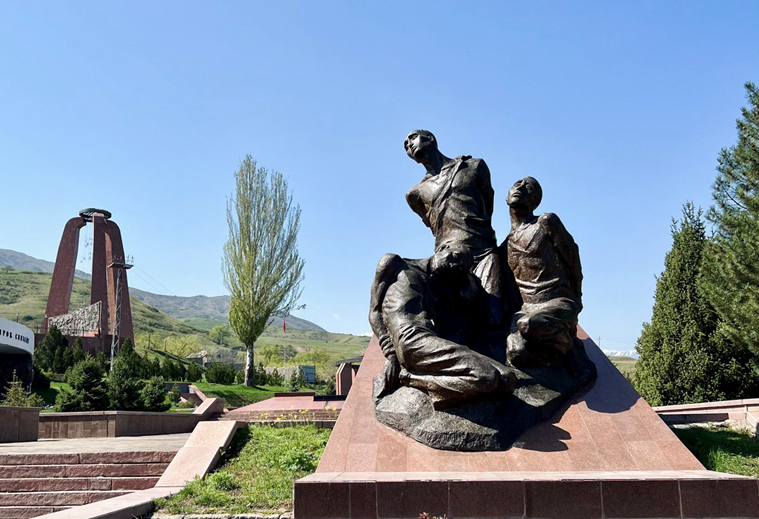
In 2010, Dinara and her students received a message from the spirits, according to which the political turbulence in the country (including two revolutions in 2004 and 2010, which overthrew presidents) was caused by the discontent of the spirits whose bodies had been thrown together into a furnace shaft in 1938 and reburied in Ata-Beyit in 1991. According to this message, the spirits formed a “muddy ball” that rolled toward the government building because, if urban legend is to be believed, this was the location of the NKVD (People’s Commissariat for Internal Affairs, in Russian: Народный Комиссариат Внутренних Дел) headquarters, in whose basements these people were allegedly executed. The shaman and her students traveled from the Talas region to the Chui region, tied a 41-meter-long (a symbolic number in Kyrgyz culture) white cloth around the burial site in Ata-Beyit, and recited prayers at length. They then returned to the Talas region, sacrificed a ram, prepared a ritual meal, and buried the cloth in a holy place. Thus, this white cloth, which connected the worlds of the living and the dead, connected two mazar: the new Ata-Beyit and the old Manas-Ordo, understood as the heart of Kyrgyz tradition and history. Through this, the spirits of the victims of Stalin’s repressions were infused with the sacred power kasiet. For six months, Dinara and her students prayed for each of the deceased, and received a separate assignment from the spirits to remember Ludwik Krynicki, a Pole executed along with the others, for several years. After the spirits were satisfied, they stopped demanding vengeance, and the political situation in the country stabilized.
This case study can be complemented by numerous others demonstrating the connection between the cult of sacred sites and the memory of events in modern history. These include, for example, burial sites of participants and victims of the civil war (such as Sheyit-Baba in the Batken region), as well as the graves of storytellers, poets, religious and political figures, and shrines associated with historical antiquity, such as the hujra (prayer house) of Zahir-ud-din Muhammad Babur in Osh. As a complex, multifaceted cultural and historical phenomenon, shamanism in Central Asia (Basilov 1992) is currently being actively supplemented by new transcultural borrowings, including elements of global esoteric discourses. This is due to its fundamentally high inclusiveness, also reflected in commemorative spiritual practices. My informants conduct their rituals for spirits of various origins and ethnocultural backgrounds, including both ancient Turkic deities and heroes, Islamic prophets and ascetics, and Christian saints, as well as the spirits of people of Russian, Ukrainian, and Polish origin who inhabited Soviet Kyrgyzstan.
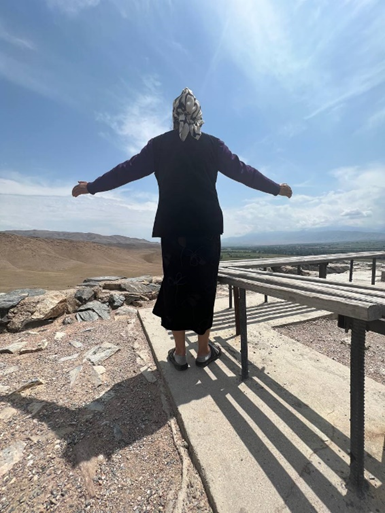
Spiritual commemoration can be described as a dynamic phenomenon, where the past is rediscovered in order to create the identity of a social group in the present. This shamanic commemoration takes place not only in a continuum that is alternative to state and conventional commemorative practices (days of remembrance, public lectures, museum work, civil activism), as well as Islamic practices of remembrance, but also demonstrates an alternative rationality. The basis of this rationality is direct participation and involvement in a living history that includes spirits and their development, and which exists parallel to the mundane political history of our world. Here, a personal connection is established with figures from the past, and the person who participates in such commemoration becomes an element in the ontological chain of the living and the dead, experiencing contact with them. They are literally involved in history, rather than just standing before it as a fixed object.
When spirits are healed through various rituals, social memory is clarified and reassembled. At the same time, the spiritual world (kayip duino) opens up as a space for constructing the past and, consequently, the future, as a realm of potentiality, a source of existential projection. The spirit temporarily moves from the realm of the dead to the realm of the living, communicating its will through an intermediary, a medium or a shaman. This spirit carries out the transfer of historical memory, the narratives of which it represents. The liminality of pilgrimage practices in sacred spaces represents a connection between heaven and earth, a mixture of the realms of mortal humans and immortal spirits, as well as of traditional practices named kyrgyzchylyk (Aitpaeva 2008) and reinterpreted Muslim rites (musulmanchylyk). This liminality also entails the liminality of human existence between the past and the future, where subjectivity is constructed, whether it concerns individual or ethnocultural identity.
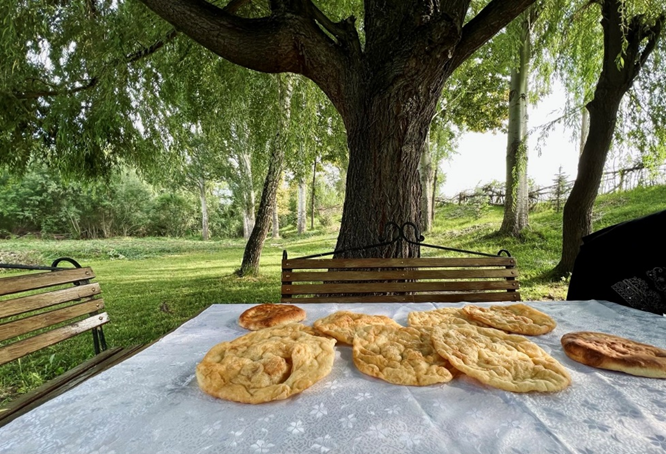
Thus, holy places and the narratives associated with them are not merely cultural heritage from the past. They actively transmit historical memory, adapting it to contemporary contexts, integrating multiple cultural layers, and forming collective knowledge systems that preserve the spiritual, moral, and historical landmarks of society.
#
Dr. Nestor Manichkin is an associate researcher at the French Institute for Central Asian Studies (IFEAC) in Bishkek and a visiting researcher at the Centre for Advanced Studies in the Humanities and Social Sciences, Friedrich-Alexander-Universität Erlangen-Nürnberg, Germany. His research interests include issues of anthropology of religion, syncretic cults, ritual possession, and altered states of consciousness. He is the author of two monographs: Shamanism and Spiritual-Magical Practices of the Kyrgyz (2020; In Russian) and Invisible Horsemen. Cults of Possession Through the Eyes of Scholars (2024; In Russian).
References:
- Abdrakhmanov, Bolotbek. Book of Victims of Political Repressions of the Kyrgyz Republic (1920–1953) [Книга жертв политических репрессий в Кыргызской Республике (1920–1953)]. Bishkek: Biyiktik Plus, 2021. (In Russian)
- Aitpaeva, Gulnara. “Kyrgyzchylyk: Searching New Paradigms for Ancient Practices.” Anthropological Journal of European Cultures, vol. 17, no. 2, 2008, pp. 66–83.
- Basilov, Vladimir N. Shamanism Among the Peoples of Central Asia and Kazakhstan [Шаманство у народов Средней Азии и Казахстана]. Moscow: Nauka, 1992. (In Russian)
- Espirito Santo, Diana. Developing the Dead: Mediumship and Selfhood in Cuban Espiritismo. Miami: University Press of Florida, 2015.
- Halbwachs, Maurice. On Collective Memory. Chicago: The University of Chicago Press, 1992.
- Manichkin, Nestor A. Shamanism, Spiritual and Magical Practices of the Kyrgyz People [Шаманизм и духовно-магические практики кыргызов]. Moscow: Smart Event, 2020. (In Russian)
____
CAS-E blogs may be reprinted with the following acknowledgment: “This article was published by CAS-E on January 29th, 2025.”
The views and opinions expressed in blog posts and comments made in response to the blog posts are those of the author(s) and do not necessarily reflect the views and opinions of CAS-E, its founders, its staff, or any agent or institution affiliated with it, nor those of the institution(s) with which the author is affiliated.