Robert André LaFleur
On a foggy day in October 2006, I stared at a wall of stone rising before me. Few images in China are as familiar to everyone who has ever lived there than the picture of the winding staircase—and the steep final climb—up to the South Gate of Heaven on Mt. Tai, in Shandong province. It is a destination that has been said to make one’s life complete, and countless travelers over the centuries—from kings, emperors and Communist Party officials to peasants, travelers, and UNESCO Heritage Site tourists—have made the ten-kilometer hike from the elaborate temple dedicated to the mountain in the city of Taian, through gates, arches, and more temples, and finally up to the “eighteen bends” in the path to the place called heaven’s gate.
Mt. Tai is arguably the most written about mountain in the world—a textual staple in Chinese literature since the Book of Documents, compiled almost three thousand years ago, and the focus of (countless) poems, essays, and inscriptions. The hiker climbs the seven thousand steps to the summit through a cavern of writing—on the left and right on the rock face, above as one passes under gates and arches, and even below, where the path itself has given itself over to textuality. On Mt. Tai, the rock is carved with over a thousand poems and inscriptions.
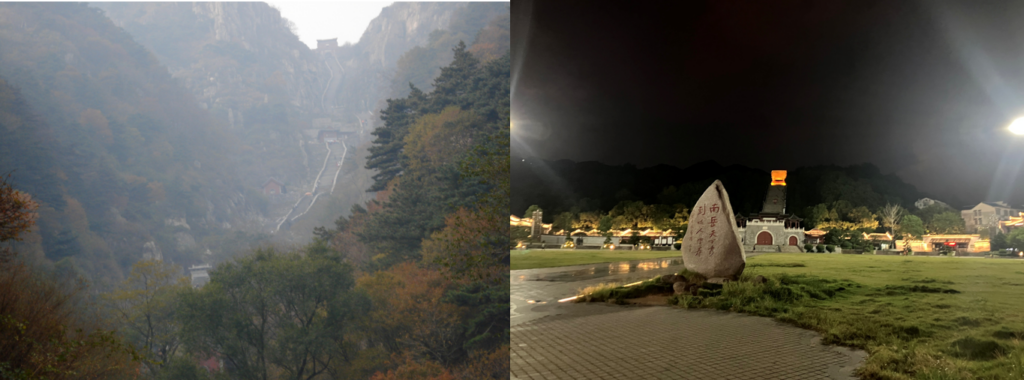
Mount Tai is the eastern peak in a cluster of five sacred mountains (east, south, center, west, and north, in that order). It is, for symbolic as well as quite practical reasons, associated with springtime, birth, beginnings, and the color green. It is the place where—day after day and year after year, in the relentless movement of Chinese cosmology—time begins again. With my training in both history and anthropology, I was determined to study the mountain through its literature, as well as on the ground.
Flash forward an entire year. After climbing the peak for perhaps the fortieth time in twelve months, I stopped, almost literally in my tracks. What was I doing? Every day I woke, explored the eastern mountain, and then returned to my hotel, only to repeat the experience the next day and the next. It was a Chinese cosmological version, I thought to myself, of the 1993 movie Groundhog Day.
I knew, of course, that there were four other mountains, and it only occurred to me then that the five mountain network should be the true focus of my studies. Within weeks, even with a busy teaching schedule back home, I had climbed all five. I found myself in my true element, as I like to think of it, studying what I like to think of as the ethnography of a concept—not only the granular details on and around each mountain, but the cosmology of the five mountain network, as well.
Each mountain is grounded in regional economies and local religious practices; each has been a significant pilgrimage destination for the better part of three millennia. There is nothing quite like it in the ethnography of tourism, but tourism is only part of the interest that it presents to those of us who study esoteric practices.
Over the next eighteen years, I read everything I could find published about the mountains over 3,000 years—from the Book of History to the most recent self-published pamphlet on the new trail up northern Mt. Heng, which I received as a gift from a custodian in a little temple halfway up the mountain. Moreover, I have “read” the mountains themselves. That is because, for almost thirty centuries, poets, statesmen, and everyday travelers have inscribed their thoughts onto the rock face in elegant, flowing script. The mountain paths are corridors of text, even as they teem with chattering, voluble pilgrims walking the stone trails. They have ever been so.
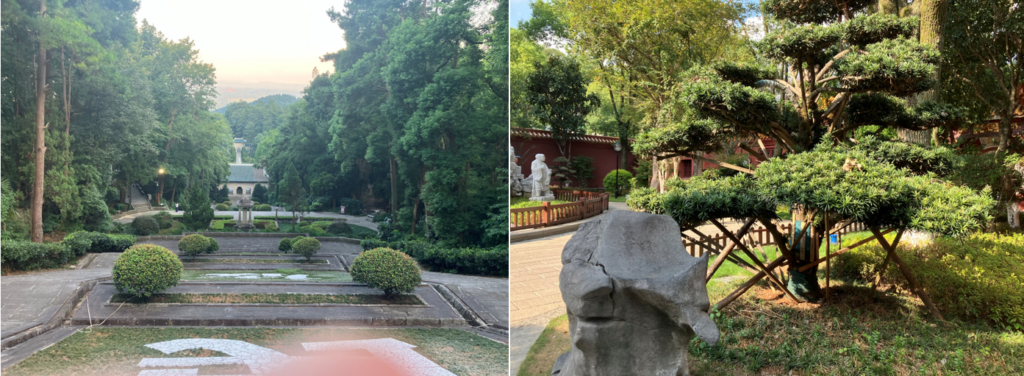
I have studied the books, read the mountains, and talked to the travelers, spending 1,200 days on and around the five mountains since that autumn day in 2006. As I reflect upon their importance to students of esotericism, I see the mountains and their adjoining territories as arenas for a complex interplay of factors that support esoteric dispositions. These include a formidable array of ritual and divinatory practices that play out in back corners of the more than thirty temples on each mountain, as well as in stalls and shops throughout the cities at their bases. I have witnessed the assessment of spiritual weight of children, simple marriage forecasts, and exorcisms in these half-hidden locations over the years.
These practices are not uncontested, however, and that is what makes them especially fascinating when considered in terms of CAS-E’s new focus on the intersection between institutions, media, and efficacy. I have spoken to multiple local officials in the mountain areas, and they express conflicted sentiments about the pressure they feel to promote a form of tourism that centers upon making obeisances to various spirits celebrated on the mountains and their training (backed by educational institutions, the Communist party, and media) that emphasizes “anti-superstition.”
The mountains are places where these direct tensions play out, sometimes in dramatic fashion (as when travelers frequently confront each other over “superstitious” practices) and, more often, in the conflicted answers people give for buying incense, going to the temple burners, and praying for progeny, longevity, or other hopes. “It’s just in case” is the most common expression, but the tensions, whether personal or social, large or small, play into the broader history of a Chinese society that, traditionally, had temple propitiation as standard procedure for almost every family (as it remains in many parts of the Chinese speaking world, from Hong Kong to Taiwan, Singapore, and among many of those living abroad throughout the world.
It is difficult to open serious conversations about these matters in the general flow of daily life in China, broadly speaking. On the mountains, it becomes a center of conversation, and there is much to learn about how institutions, media, religious belief, and cultural practices all come together. That is the work I will be continuing during my time at CAS-E.
#
Robert André LaFleur is an anthropologist and historian focusing on the intersection of text and culture in Chinese life. His work explore topics such as the Chinese almanac’s role in popular religion, the “exilic imagination” among scholars in the Northern Song dynasty (960-1127), and literary borrowing in the Chinese historiographical tradition. He is the author of China: Global Studies (2003; substantially revised and expanded 2010). LaFleur earned his doctorate from the University of Chicago’s Committee on Social Thought. A professor of history and anthropology at Beloit College, he holds the George Russell Corlis Chair in History, and has chaired the Asian studies program and history department.
____
All pictures are taken by author.
____
CAS-E blogs may be reprinted with the following acknowledgment: “This article was published by CAS-E on January 29th, 2025.”
The views and opinions expressed in blog posts and comments made in response to the blog posts are those of the author(s) and do not necessarily reflect the views and opinions of CAS-E, its founders, its staff, or any agent or institution affiliated with it, nor those of the institution(s) with which the author is affiliated.